By Solomon Wiesen, TLV Beaches. Last reviewed October 2026.
Welcome to Eilat! You probably know that while Tel Aviv beaches have the energy, Eilat has the soul of the sea. We’re talking about the Red Sea, baby! That turquoise, coral-filled bathtub that stays warm and connected almost year-round.
TLDR: Coral Beach Nature Reserve (Hof Almog) is the best Eilat beach if you appreciate nature. If you would rather have a party, go with Hananya Beach on the North Beach strip.
At a glance
- Coastline: about 12 km, split into the sandy North Beach and the coral-rich southern shore
- Lifeguards: only on the four declared municipal beaches, all on North Beach (Hananya is one of them), all year, 09:00 to 17:00 in summer
- No municipal lifeguards: Mosh’s, Dekel, Dolphin Reef, Migdalor and Princess
- Coral Beach Nature Reserve in 2026: 40 NIS adults, 25 NIS children; 09:00 to 18:00 in summer and to 17:00 in winter, with last entry an hour before closing; snorkel set rental 50 NIS
- Dolphin Reef in 2026: 74 NIS adults, 55 NIS children; closed most Sundays
- Buses south: Egged lines 30 and 15 from the Central Bus Station area; line 30 is faster, about 9 minutes to Coral Beach, roughly every 20 minutes
- Accessible beach: the Hananya stretch of North Beach has a floating wheelchair, accessible showers and shade
People come down to get away from the center, to recover after a hike in the Negev, or just to work on a tan. The first thing to know: Eilat’s coastline splits into two very different halves. You’ve got the North Beach (sandy, hotel-heavy, action-packed) and the South Beach (pebbly, chill, coral-rich).
So, where should you drop your towel? Don’t worry, I’ve done the “hard work” of testing the waters (literally) to bring you the Top 7 Beaches in Eilat. Bring a snorkel mask and SPF 50.

Jump to a Beach
Eilat isn’t a big city, but the shoreline packs in an absurd amount of variety for a strip that’s about 12 kilometers long. I’ve been coming down here for years, sometimes for a long weekend with friends, sometimes dragging family along, once memorably for a “quick day trip” that turned into three days because I forgot how hypnotic the Red Sea can be when you’re floating face-down over a reef. Here’s my honest take on seven of the beaches, with directions from the Central Bus Station (Tahana Merkazit) and a map for each.
Quick note before we dive in: the Central Bus Station is on Hatmarim Boulevard, and lines 15 and 30 run down the coastal road to the southern beaches (line 16 is line 15 coming back). Cabs are everywhere, and the whole town is walkable or scootable if you’re not in a rush.
Mosh’s Beach (Hof Mosh)
Mosh’s is one of those beaches that feels like a local secret even though it’s not really a secret at all. It’s at the start of the southern shore, right next to Dekel Beach, and it has a scruffy, easygoing personality that I find irresistible. The sand is coarse and there’s a fair bit of pebble underfoot, so bring water shoes unless your feet are made of leather.
The first time I went was on a friend’s recommendation. He told me, “Skip the big beaches, go to Mosh’s, order a beer, and just sit.” I did exactly that. I remember the plastic chair was crooked, the umbrella above me was sun-bleached to a color that no longer existed in nature, and a stray cat made itself comfortable on my towel for about an hour. It was perfect. The snorkeling right off the shore was surprisingly good: I saw a parrotfish within ten minutes of getting in the water. The crowd leans young and relaxed, and on weekends there’s often music drifting from the little beach bar.
Getting there from the Central Bus Station: Take bus 30 or 15 south and get off at the Dekel Beach stop (ask the driver for “Hof Mosh”); on line 30 it’s only a few minutes from the station. From the bus stop on Mitzrayim Road, it’s a 2–3 minute walk down to the water. It’s only about 2 km from the station, so a taxi takes just a few minutes.
Coral Beach Nature Reserve (Hof Almog)
This is the one I tell every first-time visitor to put at the top of their list. Coral Beach is a protected nature reserve, which means you pay an entrance fee (40 NIS for adults and 25 NIS for children in 2026), but in return you get one of the best shore-accessible reefs on the planet. I’m not exaggerating. You walk to the end of a small wooden bridge, lower yourself into the water, and you’re floating above a living reef wall in about three seconds.
I’ll never forget my first time here. I was renting a snorkel and mask from the little kiosk, half-listening to the safety briefing because I was so excited, and within minutes of getting in I came face-to-face with a lionfish drifting under a coral overhang. I genuinely yelped into my snorkel. Since then I’ve seen moray eels, schools of yellow goatfish, and once a sea turtle paddling along the deep edge of the reef. The reserve is well-maintained, the staff are strict about not touching anything (good), and there are shaded grass areas to rest between swims.
One tip: go early. By 11am the parking lot is full and the best snorkel spots are crowded. I’ve made the early-morning pilgrimage with a thermos of coffee more than once, and it’s always worth it.
Getting there from the Central Bus Station: Bus 30 is the quick one, about 9 minutes from the station. Bus 15 loops past the North Beach hotels first and takes about 21 minutes. The reserve has its own clearly marked stop. By taxi it’s roughly 15 minutes. You can also rent a bike from town and ride the coastal path; it’s a flat, pleasant ride that takes 30–40 minutes.
Dolphin Reef Beach
Dolphin Reef is its own thing: part beach, part marine sanctuary, part attraction. There’s an entry fee (74 NIS for adults and 55 NIS for children in 2026, and it is closed most Sundays), and the place is built around a population of bottlenose dolphins that live in a large open enclosure in the sea. Whether you love or hate the concept will depend on your views about marine animals in captivity, and that’s a conversation worth having. What I can say is the dolphins are not performing and they’re not doing tricks for fish. They live in a large netted-off stretch of sea, and the reef’s own site says a gate to the open sea will be opened in due time.
I went on a hot August afternoon with my sister, who is dolphin-obsessed in a way that hasn’t changed since she was eight. We paid the entrance fee, found a hammock in the shaded grove near the back, and basically didn’t move for four hours. Every so often a dolphin would surface near the floating platforms and the whole beach would gasp in unison. The “relaxation pools” (saltwater pools with underwater music, which cost extra and are for adults only) are gimmicky but lovely if you’ve had too much sun.
It’s not a swim-and-snorkel-anywhere beach, more of a managed visit. But the atmosphere is unlike anywhere else in Eilat, and the food at the on-site restaurant was better than it had any right to be.
Getting there from the Central Bus Station: Bus 15 southbound; get off at the Dolphin Reef stop, which the driver will call out. It’s about 10–12 minutes from the station. Walking from the bus stop to the entrance takes 2 minutes. A taxi runs around 25–35 shekels depending on traffic.
Migdalor Beach (Lighthouse Beach)
Migdalor (“lighthouse” in Hebrew) is named for the small lighthouse on the hill just across the road. It’s on the southern coast, between Coral Beach and the Egyptian border, and it has the kind of laid-back, slightly-bohemian atmosphere that makes you want to extend your stay. There’s a beach bar, sun loungers, decent snorkeling (not Coral Beach level, but respectable), and a crowd that skews toward divers, backpackers, and people who clearly know each other.
My memory of Migdalor is tied to a sunset I won’t forget. I’d come for an afternoon swim and stayed too long, the way you do when you’re on holiday and have nothing pressing to do. As the sun dropped behind the Sinai mountains across the gulf, the entire bay turned this impossible coral-pink color. Someone at the bar started playing acoustic guitar (badly, but enthusiastically) and a few people joined in singing. I bought a cold beer, sat in the sand, and felt smug about my life choices. It’s that kind of place.
The snorkeling is best at the southern end of the beach, closer to the rocky outcrop. I’ve spotted clownfish in the anemones there more than once.
Getting there from the Central Bus Station: Bus 15 toward Taba, exit at the Migdalor / Lighthouse stop. About 18 minutes by bus, 13 by taxi. If you’re walking from Coral Beach Nature Reserve, it’s about a 15-minute walk south along the coast road, a bit over a kilometer.
Princess Beach
Princess Beach is the southernmost beach in Israel; any further south and you’re in Egypt. It sits opposite the old Princess Hotel (hence the name), which has been closed for about a decade, and it feels appropriately end-of-the-world. There’s something special about standing on a beach where you can see the Sinai mountains close enough to touch, the Egyptian border crossing literally a few hundred meters away.
I went there on a winter weekday, January maybe, when the air was warm but the water was bracing. The beach was nearly empty. I remember walking the entire stretch and counting maybe a dozen people. There’s a reef just offshore, and I waded in despite the cold and found myself alone above a coral garden, with only the sound of my own breath through the snorkel. It was meditative in a way the busier beaches never are.
Facilities are minimal and there are no lifeguards, so come prepared. The sand is mixed with pebbles, water shoes recommended again. The upside of the remoteness is the quiet and the cleanliness.
Getting there from the Central Bus Station: Bus 30 or 15 to the Princess Hotel stop near the Taba border crossing: about 11 minutes on line 30, about 24 on line 15. From there it’s a 3–4 minute walk. A taxi from the station takes about 18 minutes; expect roughly 45 to 70 shekels. If you’re driving, there’s free parking near the border crossing.
Dekel Beach
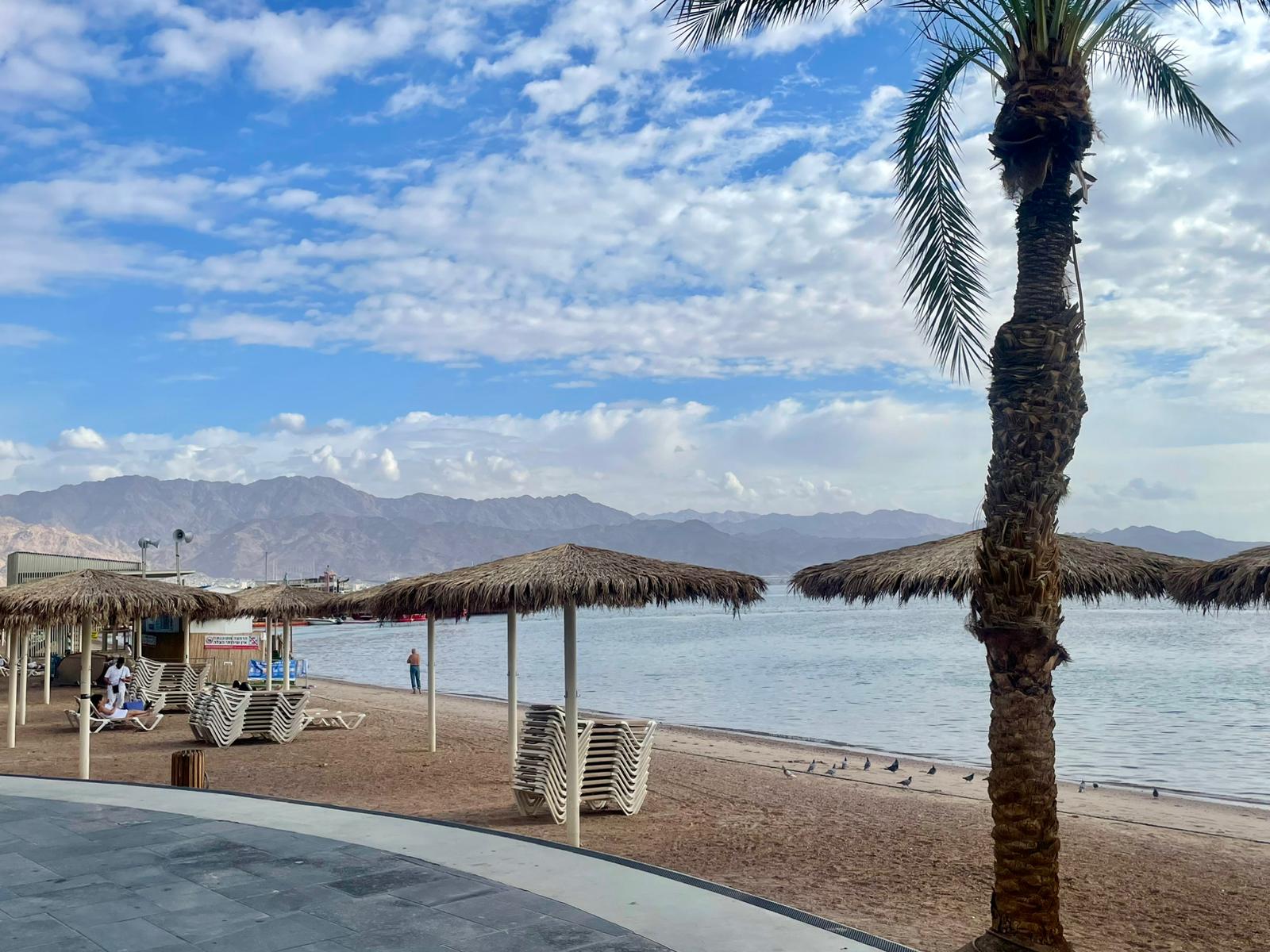
Dekel (“palm tree”) Beach is one of my comfort beaches. It’s the first beach on the road south, about 2 km from the Central Bus Station, and it strikes a sweet middle ground between the touristy chaos of North Beach and the quieter southern beaches. There are palm-thatched umbrellas, sun loungers you can rent for a reasonable fee, a beach bar and, crucially, proper showers and bathrooms.
I have a recurring memory of arriving at Dekel after a hot, exhausting morning of haggling at the duty-free shops. I plonked down on a lounger, ordered a watermelon-and-feta salad and an icy lemonade, and watched a group of kids attempting to paddleboard while their parents laughed from shore. The water here is calm, shallow for a long way out, and great for families or for anyone who just wants to float without thinking about reefs or currents.
It’s not a snorkeling beach (the sea floor is mostly sand), but for a relaxed swim, a long lunch, and a nap, Dekel is hard to beat. Sunsets here look out toward the Jordanian mountains across the gulf, which turn a deep rose color in the evening.
Getting there from the Central Bus Station: This one’s easy. Bus 30 gets you to the Dekel Beach stop in about 4 minutes, or it’s a 25 to 30 minute walk (about 2 km) south from the station along the coast road. A taxi runs 20–25 shekels and takes about 5 minutes.
Hananya Beach (North Beach)
And finally, the big one: North Beach. Hananya Beach is the main public beach in the middle of the hotel district, stretching along the promenade in front of the major resorts. It’s busy, it’s loud, it’s full of music from the bars and shrieks from the kids on the inflatable obstacle courses, and honestly, it’s a lot of fun if you embrace it for what it is.
My most vivid North Beach memory is from a summer night a few years back. I’d been to a wedding earlier in the evening, was still in my nice shoes, and somehow ended up walking along the promenade at 1 a.m. with a group of friends. The bars were still going, people were swimming under the moonlight, and someone was selling fresh churros from a cart. We took our shoes off, sat in the still-warm sand, and watched the lights of the boats in the marina bob in the dark water. Not exactly a quiet nature experience, but pure, unfiltered Eilat.
By day, North Beach has everything: paddleboat rentals, parasailing, jet skis, beach bars every fifty meters, ice cream stands, and lifeguards. The water is calm and good for swimming. It’s not a beach for solitude or for snorkeling, but it’s the social heart of the city.
Getting there from the Central Bus Station: Walkable: about 13 minutes on foot heading southeast toward the lagoon and the hotel zone. You’ll know you’ve arrived when you hit the promenade. By taxi it’s a 5-minute ride and barely worth the fare. Pretty much every local bus line passes within a couple minutes’ walk.
Whichever beach you pick, bring more water than you think you need, more sunscreen than you think you need, and water shoes. The Red Sea will reward you for showing up prepared.
See you on the Eilat beach! 🌊🌴
Disclaimer: Opening times and prices are subject to change, especially during holidays and Shabbat. Always check ahead!
Best Eilat Beaches For…
Not every Eilat beach is right for every visitor. After enough trips down here, you start to figure out which beach fits which mood, and which crowd. Here’s my honest sorting of the city’s beaches by what you’re actually looking for. If you’re traveling with toddlers, a wheelchair, a serious snorkel mask, or a group of friends ready to drink margaritas until sunset, this is the cheat sheet.
Best Eilat Beach for Kids
For kids, the magic combination is shallow water, calm waves, easy access, and stuff to do when they inevitably get bored of the sea twenty minutes in. Dekel Beach is my top pick. The water stays shallow for a long stretch out, the sand is soft enough for castle-building, there are loungers and umbrellas for parents to camp under, and the beach bar has kid-friendly snacks within whining distance. I’ve watched my nieces spend entire afternoons there without ever needing to go further than knee-deep.
Hananya (North) Beach is a close second if your kids are old enough to handle a busier scene. The promenade right behind it has ice cream stands, paddle boats, banana boat rides, and inflatable water obstacle courses anchored offshore. It’s loud and slightly chaotic, but for kids over 7 or 8, that chaos is the whole appeal.
I’d skip Coral Beach Nature Reserve with very young children: the reef walkways are great for older kids who can snorkel responsibly, but toddlers and the strict no-touching reef rules don’t mix well.
Best Eilat Beaches for Parties
Hananya (North) Beach, no contest. This is where Eilat’s party energy lives. Beach bars run from morning into the night, music gets louder as the sun drops, and on summer weekends the promenade is basically one continuous celebration. I’ve stumbled into impromptu dance circles on the sand here more than once. There’s no pretense: it’s loud, it’s touristy, it’s a great time.
For a slightly more grown-up scene with the same energy, Mosh’s Beach picks up on weekend nights, especially in summer. The crowd skews young, the beach bar plays good music, and the mood is less spring-break, more relaxed cocktail-and-conversation. I’ve had some of my best Eilat nights here, sitting on a low cushion with a cold beer while someone DJs from a laptop balanced on a cooler.
Migdalor Beach deserves a mention too; its parties tend to feel a little more local and a little less commercial. Good for when you want music and people but not stag-do energy.
Best for Families
“Family” covers a lot of ground (toddlers, teenagers, grandparents), so the best family beach is one where nobody in the group gets bored. Dekel Beach wins here again because of how complete the package is: shaded loungers for the grandparents, calm shallow water for little kids, paddleboards and rentals for teens, and a proper restaurant on-site so nobody has to pack lunch. Clean bathrooms and showers also matter more than people admit until they’re traveling with kids.
Hananya (North) Beach is the runner-up, especially for larger family groups who want to spread out, do their own thing, and meet up for dinner on the promenade afterward. Hotels back right onto the beach so logistics are easy.
If your family is the adventurous, nature-loving kind with older kids, Coral Beach Nature Reserve is a brilliant family day out, but plan it as an outing, not a hangout. You go, you snorkel, you marvel at the reef, you eat lunch, and then you head somewhere else for a relaxed afternoon.
Best for Sightseeing
If by sightseeing you mean “I want to stand somewhere and look at something memorable,” Princess Beach is the unbeatable choice. You’re at the southernmost tip of Israel, with the Egyptian border crossing visibly close, the Sinai mountains rising dramatically across the gulf, and Jordan’s Aqaba shimmering across the bay to the east. It’s geographically wild: four countries’ shorelines visible from one spot. I’ve taken first-time visitors here just to watch their faces when they realize where they’re standing.
Migdalor Beach is the runner-up: the little lighthouse, the views toward the Sinai mountains, and a great sunset angle make it photogenic in a way the more developed beaches aren’t. I’ve taken some of my favorite Eilat photos here.
For a different kind of sightseeing (boats, hotels, marina life, the whole “look at Eilat being Eilat” experience), Hananya (North) Beach and its promenade is the spot. People-watching here is a sport.
Best for Handicap Accessibility
Hananya (North) Beach is the most accessible beach in Eilat by a wide margin. The promenade is paved and flat, runs the full length of the beach, and connects directly to hotels, restaurants, and parking. Accessible bathrooms are available along the strip, and several access points have ramps down to the sand. Some sections offer beach wheelchairs (with chunky balloon tires that roll on sand); ask at the lifeguard stations or the larger hotels nearby. The municipality’s page for this stretch (the Leonardo Plaza, Maman and Hananya beach) lists a floating wheelchair at the lifeguard station, accessible showers and shade.
Dekel Beach is also well-set-up, with paved pathways from the parking area to the loungers and accessible bathrooms. Because the beach itself is compact and well-organized, distances are short and manageable.
I’d be more cautious with Coral Beach Nature Reserve, Mosh’s, and Princess Beach: these have rockier terrain, fewer paved paths, and limited accessible facilities. Dolphin Reef has paved paths throughout the property but the route to the actual water involves wooden decks and some steps, so it’s mixed.
A note: accessibility infrastructure changes and improves over time, so it’s worth calling ahead or checking with your hotel concierge for the latest on beach wheelchair availability and ramp locations.
Best Beach for Snorkeling in Eilat
This category has a clear winner: Coral Beach Nature Reserve. There is no other shore-accessible reef in Israel that comes close. You walk to the end of a marked entry bridge, drop into the water, and you’re floating above a living reef wall: lionfish, parrotfish, schools of yellow goatfish, the occasional turtle if you’re lucky. The reserve enforces no-touching rules and maintains buoy-marked safe corridors, which keeps the reef healthy and your snorkel experience excellent. Bring your own gear or rent at the kiosk, and go early to beat the crowds.
Migdalor Beach is my favorite “casual snorkel” runner-up. You won’t get the Coral Beach intensity, but the southern end of Migdalor has rocky outcrops with anemones, clownfish, and a respectable variety of reef fish. It’s free, less crowded, and lets you snorkel without the formality of a nature reserve.
Mosh’s Beach has decent snorkeling close to shore, better than you’d expect. Not destination-worthy, but a nice bonus if you’re already there.
Skip Dekel and Hananya for snorkeling entirely. Sandy bottoms, no reef.
Best for Swimming
For an actual swim (laps, long strokes, no worrying about coral underfoot), Dekel Beach is excellent. The sea floor is sandy, the water is calm, and the gentle gradient means you can swim parallel to shore in comfortable depths without surprise drop-offs. Keep in mind that Dekel is not a declared municipal beach, so there is no lifeguard.
Hananya (North) Beach is the other strong choice. Long stretch of calm water, well-lifeguarded, designated swim zones marked off from boat traffic and water sports. Good for everything from a quick dip to a serious morning swim before breakfast.
Princess Beach is great for swimming if you want quiet: the water is calm and clean, and the beach is far less crowded than the northern stretch. The downside is fewer facilities and no lifeguards.
I’d be cautious about swimming at Coral Beach Nature Reserve or Migdalor: you can swim there, but the reef-rich seabed makes it less of a freestyle-laps environment and more of a “float carefully and admire the fish” one.
Whichever category you’re optimizing for, the good news is that Eilat is small enough that you can sample two or three beaches in a single day. My standing advice: pick one snorkel beach, one swim beach, and one sunset beach, and you’ll have a perfect Eilat day.
Sources for the practical details: the Eilat Municipality on its declared bathing beaches (Hebrew), the Israel Nature and Parks Authority page for the Coral Beach Nature Reserve (Hebrew), Dolphin Reef, the Ministry of Transport’s bus timetables for October 2026, and Maariv on the Princess Hotel (Hebrew, July 2026). Checked October 2026. The stories are my own.
Eilat is one of eight beach regions in Israel, and the only one on the Red Sea. For the rest of the coast, see our guide to all 55 beaches in Israel.

Solomon (Shlomo) Wiesen is the author and photographer behind TLV Beaches. Originally from New York, he moved to Israel in 2011 and lives in Tel Aviv, a short walk from Frishman and Bograshov beaches. Every guide on the site is written from the beach, with more than 200 of his own photos of the Tel Aviv coast. He works in marketing, SEO and startups.
Leave a Reply